Welcome back!
Ready to check out?
You're just one click away from fantastic style and even better savings!
: The book is the first to employ use cases—descriptions of how users (actors) interact with a system—to capture requirements and guide design throughout the lifecycle. Objectory Process
OOSE is a software development methodology that emphasizes the use of object-oriented concepts, such as encapsulation, inheritance, and polymorphism, to design and develop software systems. The approach focuses on creating reusable, modular, and maintainable software components that can be easily composed to form complex systems.
Liked this article? Share it with a student who keeps asking for “the Jacobson PDF.” Then show them how to build a use case diagram in PlantUML instead.
: Identifies three specific types of objects to structure the system: Entity Objects : Persistent information (e.g., "Account").
Ivar Jacobson's approach, often called , focuses on reducing the total system life cycle cost through a unified object-oriented process.
: The book is the first to employ use cases—descriptions of how users (actors) interact with a system—to capture requirements and guide design throughout the lifecycle. Objectory Process
OOSE is a software development methodology that emphasizes the use of object-oriented concepts, such as encapsulation, inheritance, and polymorphism, to design and develop software systems. The approach focuses on creating reusable, modular, and maintainable software components that can be easily composed to form complex systems.
Liked this article? Share it with a student who keeps asking for “the Jacobson PDF.” Then show them how to build a use case diagram in PlantUML instead.
: Identifies three specific types of objects to structure the system: Entity Objects : Persistent information (e.g., "Account").
Ivar Jacobson's approach, often called , focuses on reducing the total system life cycle cost through a unified object-oriented process.
*Discount applied on the current website price at the time of order. Offer only valid for new customer first contacts order over $10. Maximum discount of $100. Cannot be combined with any other offers. Promotions are subject to change without notice. We reserve the right to cancel orders that are in breach of the terms and conditions of this offer.



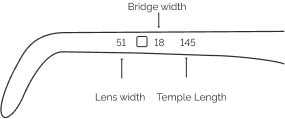
| Lens Width | Bridge Width | Temple Length | |
|---|---|---|---|
| XS | < 42 mm | < 16 mm | <=128 mm |
| S | 42 mm - 48 mm | 16 mm - 17 mm | 128 mm - 134 mm |
| M | 49 mm - 52 mm | 18 mm - 19 mm | 135 mm - 141 mm |
| L | >52 mm | >19 mm | >= 141 mm |
Buying eyewear should leave you happy and good-looking. Use our sizing tool to find frames that best fit your unique facial measurements.
Grab a regular card with a magnetic stripe on the back. Student IDs, credit cards and gift cards work well to start our online PD tool.
You may have received our paper PD measurement tool in your recent online order. In order to use this tool, place the ruler on your eyes so that the "0" lines up at the centre in between your eyes. Add up the two numbers, to get your PD. See example below:
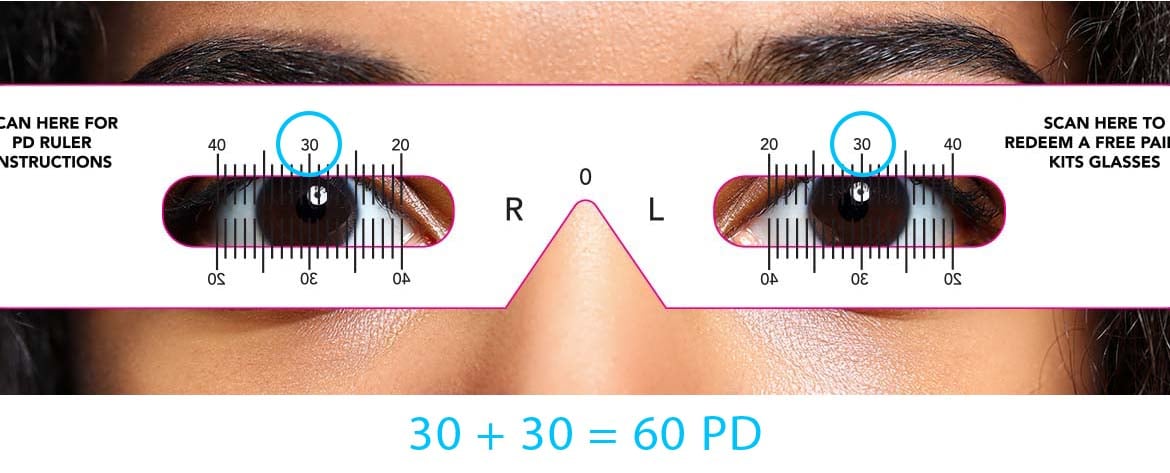
Click on this link to download and print your own PD measurement tool.
DOWNLOAD



 Check order status
 Place reorder
 Chat with us





 Use your insurance
 Help
Help